


Aligning Higher Education with the United Nations Sustainable Development Goals (SDGs)
Education
CREATED
25 Oct 2023
www.syne.com/story/aligning-higher-educa...
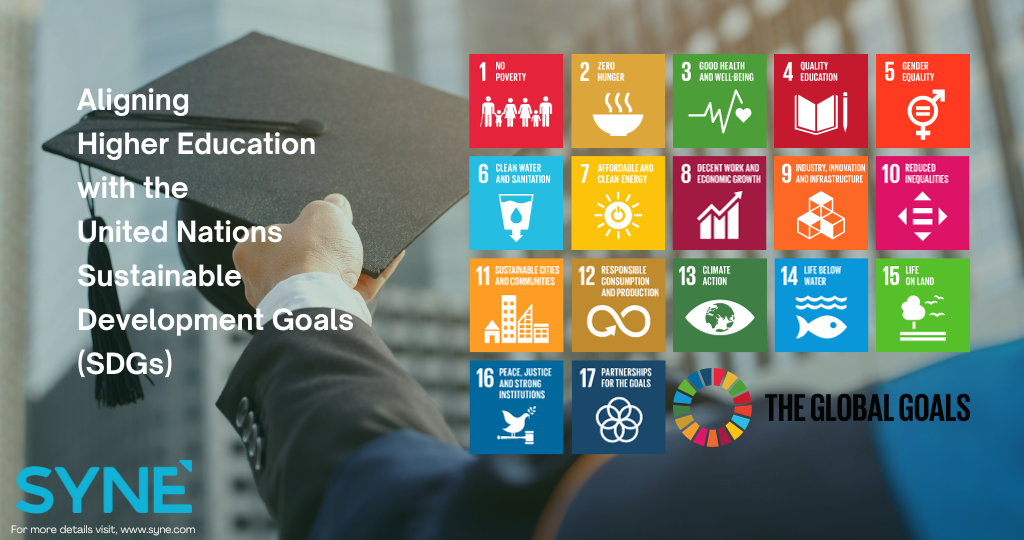
The United Nations Sustainable Development Goals (SDGs) are a set of 17 goals with 169 targets that all 193 UN member states have agreed to try to achieve by 2030. It is a universal blueprint for addressing some of the world's most pressing challenges, from poverty and inequality to climate change and environmental sustainability. SDGs are a matter of urgency, and actions by all countries, both developed and developing, to end poverty and other socio-economic and environmental problems should align with strategies that improve the standard of life and education, reduce inequality, and harness economic growth.
Though it has been eight years since the inception of these goals, the SDGs Report 2023 flagged slow progress and painted a grim picture due to the prolonged effects of COVID-19, impacts of the climate crisis, the Russia-Ukraine conflict, and a weak global economy. The lack of progress towards the goals is a universal experience, but it has been more pronounced in the Least Developed Countries.
Higher education institutions have a pivotal role to play in advancing these global goals. By aligning their educational and research activities with the SDGs, universities can foster a generation of responsible, informed, and socially conscious individuals who can contribute to sustainable development. Educational institutions have to rethink their approach so that it is in tune with the NEP which will be crucial in realising the 2030 deadline for SDGs
The Significance of Higher Education in Achieving SDGs
1. Raising Awareness and Fostering Engagement: Higher education serves as a powerful platform to raise awareness about the SDGs and engage students, faculty, and staff in meaningful discussions and actions. By integrating SDGs into curricula and campus activities, universities can inspire individuals to become global citizens with a commitment to positive change.
2. Research and Innovation: Universities are hubs of research and innovation. Aligning research with the SDGs allows for the generation of knowledge, technologies, and solutions that address pressing global issues. Research in fields such as sustainable agriculture, renewable energy, public health, and social equity is crucial for SDG achievement.
3. Capacity Building: Higher education institutions play a key role in equipping students with the knowledge and skills necessary to address complex societal challenges. This includes critical thinking, problem-solving, communication, and interdisciplinary skills. SDG-aligned education ensures that graduates are prepared for a world that increasingly demands sustainability-conscious professionals.
Practical Steps for Aligning Higher Education with SDGs
Curriculum Integration: Universities should revise their curricula to incorporate the SDGs across various disciplines. Professors can design courses that focus on the global goals and encourage students to explore how their specific fields relate to SDG targets. Moreover, interdisciplinary programs that bring together diverse perspectives are vital.
Service Learning and Civic Engagement: Encourage students to participate in service learning programs that enable them to work on projects related to the SDGs. Engaging with communities in need can foster a sense of responsibility and empathy while providing practical experience in problem-solving.
Research and Innovation: Promote research that directly addresses SDG challenges. Provide resources, incentives, and funding for projects that align with the global goals. Collaborate with governments, NGOs, and industries to ensure that research findings are implemented in real-world solutions.
Sustainability Initiatives: Implement sustainability practices within the university itself, such as energy-efficient buildings, waste reduction programs, and sustainable transportation options. This sets an example for students and the broader community, demonstrating the practical implementation of SDGs.
Global Partnerships: Universities should foster international collaborations, creating a global network dedicated to advancing the SDGs. Partnerships with universities in different countries allow for the exchange of ideas, research, and best practices in achieving these goals.
Challenges and Solutions
While aligning higher education with the SDGs is essential, it comes with challenges such as resource constraints, resistance to change, and the need for faculty development. To address these issues:
Resource Mobilization: Seek funding from government agencies, private foundations, and international organizations to support SDG-related initiatives. Use these resources to develop new courses, research projects, and community engagement programs.
Faculty Development: Offer training and incentives for faculty members to incorporate the SDGs into their teaching and research. Workshops, conferences, and professional development opportunities can equip professors with the necessary knowledge and tools.
Student Involvement: Engage students in decision-making processes related to SDG alignment. Create student-led initiatives and organizations that advocate for sustainability and monitor the university's progress toward SDG targets.
Aligning higher education with the United Nations Sustainable Development Goals is not just a moral imperative; it is an investment in a more equitable, sustainable, and prosperous future for the planet. Universities have a unique role to play as catalysts for change, nurturing a generation of leaders and professionals who are committed to addressing the world's most pressing challenges. By integrating the SDGs into their curricula, research, and campus practices, higher education institutions can contribute significantly to the global effort to achieve these goals. The ultimate goal is to empower students to be effective change agents who will lead society toward a more sustainable and inclusive future.
View Comments