

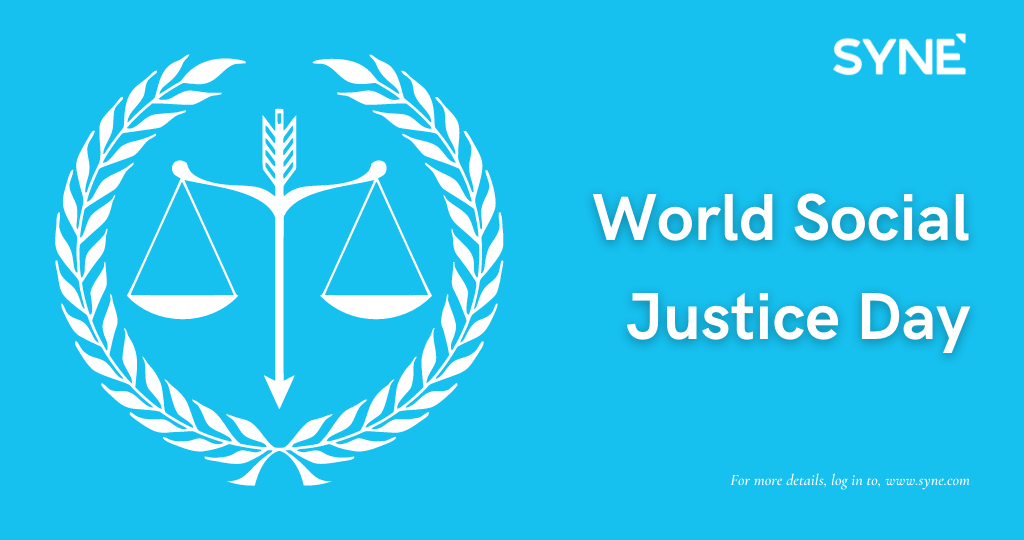
Quality of Life is Crucial: World Social Justice Day
Other
CREATED
18 Feb 2022
www.syne.com/story/quality-of-life-is-cr...
“Injustice anywhere is a threat to justice everywhere.” – Martin Luther King Jr.
Social injustice refers to inequalities in the distribution of opportunities, accessibility, and liberty within a geographical area. In an ideal world, all individuals would have equal economic, political, and social rights and opportunities. However, the world we live in is far from ideal, surrounded by injustice across countries, genders, classes, religions, and others. The United Nations General Assembly declared the 20th of February as World Social Justice Day to strive to work towards continuous social justice and fair globalisation by tackling issues such as poverty, gender inequality, unemployment, social protection, and exclusion.
For the year, 2022, the UN has adopted “Achieving Social Justice through Formal Employment’’ as the theme after considering the effect the COVID-19 pandemic had on employment or unemployment. As per statistics, almost 60% of the working population earn their livelihood in the informal sector, which is a workplace with the most social injustice. This sector does not provide job security to the employees, has poor working conditions, long working hours, lack of health benefits, unprotected labour laws etc which affect the quality of the life of the workers and families. It is necessary to bring about a system to transition from the informal sector to the formal sector.
For the transition, the International Labour Organisation (ILO) had proposed a new international standard in 2015. The labour standard aims at the transition, creation of more enterprises in the formal economy, and preventing the informalisation of the present formal jobs. Thus, this standard covers various policy areas such as, employment policies, social protection, incentives, freedom of association, the role of employers’ organisations, monitoring, and others.
A couple of the articles that are set up to ensure the protection of the employees include:
Article 20 states that, “Through the transition to the formal economy, Members should progressively extend the coverage of social insurance to those in the informal economy and, if necessary, adapt administrative procedures, benefits and contributions, taking into account their contributory capacity.”
Article 25, “With respect to the formalization of micro and small economic units, Members should reduce compliance costs by introducing simplified tax and contributions assessment and payment regimes.”
This initiative by the ILO is a beginning and has proven to be helpful in certain parts of the globe. The countries are recommended to implement these objectives in the most appropriate way that deem fit for this transition- e.g. Brazil has a national integrated policy framework adopted to combat poverty. As a result, job creation in the formal sector has increased three times in less than a decade.
Another initiative, the Self-Employed Women’s Association (SEWA) from India is working towards empowering women from the informal sector providing them with training, establishing cooperatives, financial insurance, and social security services. This model is being replicated in other parts of Asia, South Africa, and Turkey.
Indeed, we are making progress, which can be further accelerated by joining hands. All of us can contribute – let us begin by asking ourselves what we can do to promote social justice.
View Comments